One Night of Independence0 (0)
A Dutiful Wife. A British Guest. One Weekend.
IN PICS: SNEHA | CONTRIBUTED BY: DEEP (TELEGRAM)
FOR BEST EXPERIENCE, READ ON A COMPUTER OR LAPTOP
Some of my stories are loosely based on real-life incidents, but details are fictionalized. My stories involve unsafe sexual acts. I do not condone unprotected sex and recommend readers to always practice safe sex. The risk is not worth it. These are fantasies and meant for entertainment only. My stories are my hobby — an expression of my erotic side. I mean no disrespect to women featured in my stories. If you know the woman in the story, please write to me and the pictures will be taken down — no questions asked.
Happy reading!
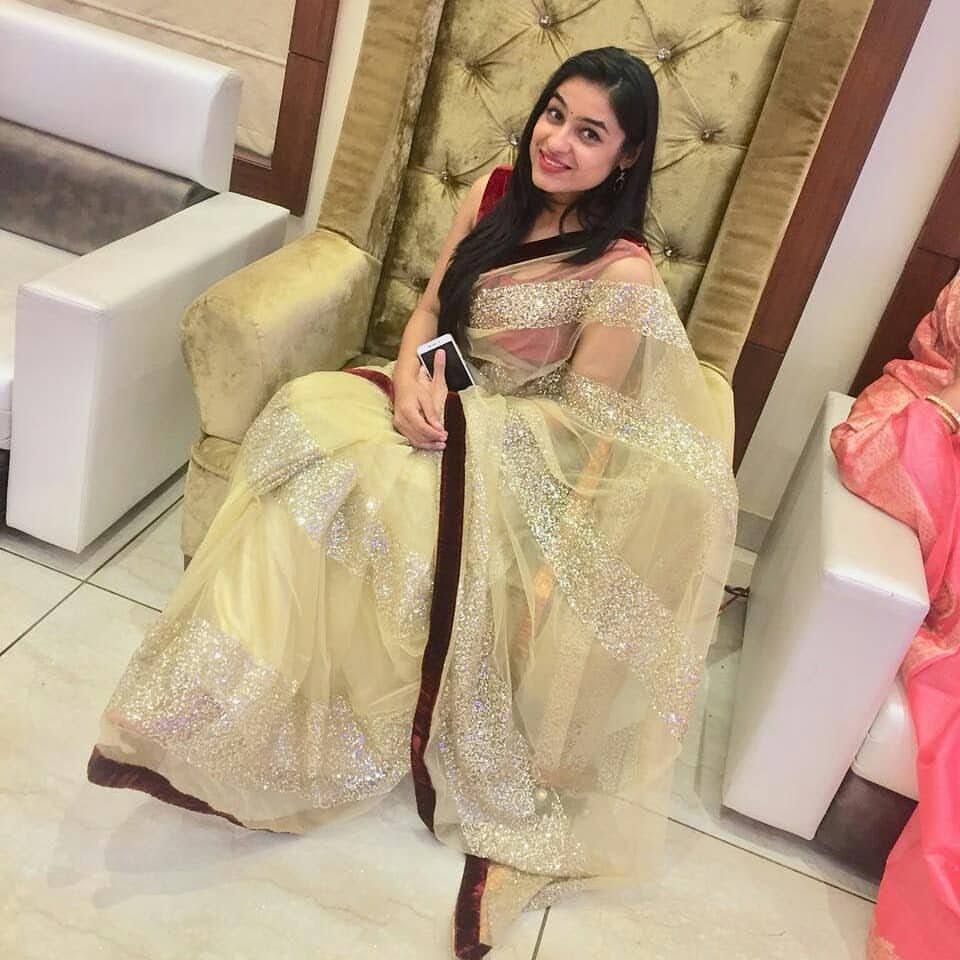
By half past five on the evening of the Sandhu dinner, I had already been perfect for an hour. I had dressed early, while the house was still being set, a deep wine silk saree, the Banarasi one with the gold zari border that Mummyji had given me for our first Diwali. I wore it for every formal occasion because it was expected and because, if I was honest, it was just beautiful.

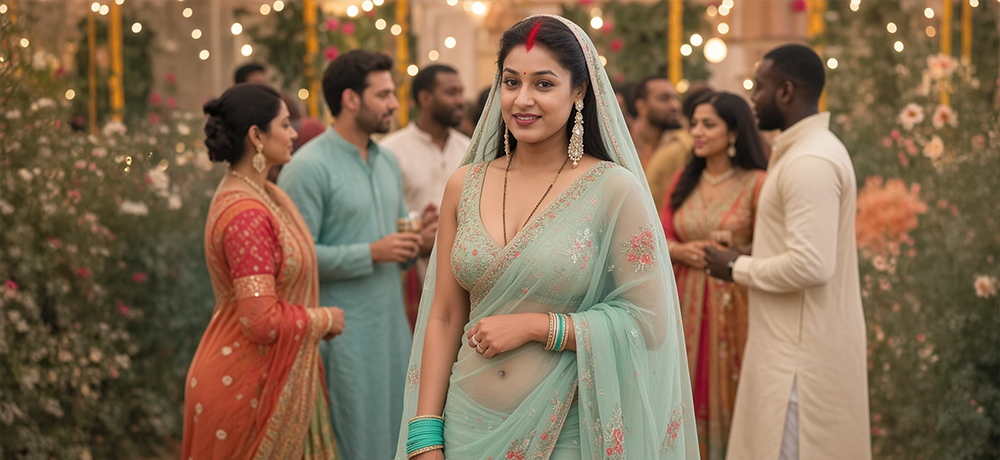
Mummyji is Ravi’s mother, Papaji his father. I had started calling them that on our wedding night at Ravi’s instruction, not suggestion. It had long since stopped feeling borrowed. The pallu was pinned at my shoulder and drawn over my head the way it was always drawn for evenings when they were present, and guests were coming and the image of the household had to be just right. I was not raised to the pallu tradition. I had learned it here, the way I had learned most other protocols of being a proper daughter-in-law of this family. Matching gold jhumkas, the choker, the churis stacked at my wrist. Bindi centred. Everything in place. I had looked at myself in the mirror for approximately three seconds before going to supervise the marigolds.
I had been managing this house for seven years. Seven years of flowers arriving at six in the morning for events nobody thanked me for, of Ravi discovering last-minute that we needed the good china and finding it already out, of guests complimenting him on the warmth of his home as if it had assembled itself. The house performed wealth effortlessly. That was the trick. Effortlessness was the hardest work there was.
The marigolds had to be raised higher. I stood in the middle of the entrance hall at half past five with my arms crossed and my pallu pushed back off my shoulders because I needed to see what I was looking at, and what I was looking at was Dilipji having threaded the marigold garlands six inches too low on the marble archway. They would catch a tall man on the forehead. We were expecting tall men.

“Six inches,” I told him. He looked at me, looked at the garlands, looked back at me, and began to climb the ladder without argument because we had done this enough times, and by now he knew that I was right.
Behind me, the caterers were moving through the house in that high-alert shuffle that meant they were nervous and trying not to show it. The Sandhu dinner for the Commonwealth delegation was an event that required everyone to perform three levels above their usual competence, and they knew it. The crystal had been out since morning. The silver was already polished to the temperature of mirrors. Upstairs, Aanya was asleep. She had given up fighting her bedtime at seven-thirty after I promised she could wear the new dress to the airport when I dropped the dignitaries next week. She had wanted to meet the foreigners. I had told her she would have her chance.
Ravi came down at six, dressed, already moving through the rooms with the energy of a man for whom every social occasion was a stage he had been cast to dominate.
“Flowers are looking good,” he said, walking past.
I said nothing. I was already moving to the kitchen to check on the appetisers.
The guests arrived in waves. I circulated as I always did: a word here, a glass redirected there, a name dropped in the right ear before two people spent an awkward minute not knowing how they were supposed to know each other. Ravi’s guests, Ravi’s world, Ravi’s event. I was the décor. Functional décor. I kept things moving without anyone registering that they were being moved.

I read the room the way I always did. The Deputy Commissioner and his wife had come separately. The Ahuja son was here without his father’s partner. There were three men from the delegation I hadn’t been introduced to yet, clustered near the bar, and one of them was standing differently from the others.
That was what I noticed first. Not his face. The way he was standing.
He was listening to someone — one of Ravi’s business contacts, from the angle of it — and he was listening. Not the nodding and the wait-for-your-turn that passes for listening at these events. He was turned toward the man, weight forward, attentive in the way that means the other person’s words are landing. It struck me as unusual enough that I kept looking longer than I should have.
He was large without being imposing. Black — the only Black man in the room, which the room was pretending, with some effort, not to have noticed — and British, from the cut of the suit and the way he held his glass. Older than the others. Late fifties, I guessed. He had the kind of face that had been interesting for a long time.
Somewhere underneath my noticing, an older voice — my grandmother’s and the cantonment aunties’ — began to file his complexion the way such voices file everything. I heard it, recognised it for the inheritance it was, and dismissed it. That voice had never once been right about anything that mattered.
I moved away. I had table arrangements to supervise.
The introduction came forty minutes later, courtesy of Papaji, who was in full patriarch mode, moving through his guests with the beneficence of a man who had built something and wanted everyone to be aware of it.
“Marcus Webb,” he said, gesturing between us. “Deputy Director-General, Commonwealth Trade Council. And this is my daughter-in-law, Sneha.”

Marcus Webb offered his hand. I took it. The eye contact held longer than the handshake required, not creepy long, just enough to read as a deliberate and respectful acknowledgement. On his side. I noted it without reacting. His eyes dropped once — briefly, to the small dark mole below my lip — and returned.
“Mrs Sandhu,” he said.
“Mr Webb.” I released his hand. Smiled the smile I had been smiling for seven years.
“Tell me —” He turned toward me with that same attentive weight I had noticed from across the room. “What do you do?”
Papaji answered before I could. “In our family, the ladies manage the home. Sneha keeps this whole household running. She has more than enough to occupy her.” He said it with warmth, the way you say a thing you have always believed and have never needed to defend.
I watched Marcus Webb receive this answer. He did not accept it.
“I’m sure that’s true,” he said pleasantly. “I was asking what she does — what she’s interested in. What she’d be doing if she had the afternoon to herself.” He looked at me. Not at Papaji. At me.

There was a small silence. Not uncomfortable on his end. He was comfortable with silence the way people are when they don’t require the room to approve of them.
“History,” I said. It came out before I could redirect it. “I read a great deal of history.”
“Any particular kind?”
“All kinds. Indian history first. Then outward from there.”
Papaji made a sound that wasn’t quite a laugh and wasn’t quite a dismissal. “Our ladies are not required to work,” he said. “Sneha has no need of it.”
“I think you misunderstood my question,” Marcus said. Still pleasant. Not combative, the tone of a man who finds the position puzzling rather than offensive, which was more disarming than offense would have been.

“I wasn’t asking about necessity. Women aren’t family property. They tend to have their own say in what they want.” He paused. “I’ve found, anyway.”
I was only half-listening to the words by then. I was watching how he argued: no performance in it, no register shift toward diplomatic softening. Just a man who meant what he said and had no investment in whether the room agreed with him.
Ravi appeared at my shoulder. “Webb-ji,” he said, with the easy warmth he put on when he needed to redirect a conversation. “Come, let me introduce you to the Commissioner. You’ll want to speak with him before dinner.” He steered Marcus away with a hand on the arm and a laugh, leaving me and Papaji standing in the middle of the room.
Across the room, Marcus Webb’s eyes found mine once before he was absorbed by the crowd.
I went back to check on the kitchen.

I slipped out near nine, when the dinner was safely underway and Ravi was holding court at the table. The balcony off the first floor sat above the garden, screened from the street by bougainvillea that had climbed the stone railing for twenty years. It was the only part of this house where I could breathe without accounting for it.

The August night was warm and still faintly scented from the garlands below. I stood at the railing with my hands folded around the stone and let myself be still. Through the tall windows behind me, the voices carried — Ravi’s laugh, the timbre of men who are comfortable. I shut them out and breathed, being me for a few moments with the sounds of the night, before returning to the party as the wife, daughter-in-law and hostess.
I heard the door within five minutes. I frowned at the intrusion on my ‘me’ time, half expecting that a member of the Sandhu staff had been sent to fetch me.
“I’m sorry if I caused you difficulty,” Marcus Webb said, from behind me.
I turned. He was in the doorway, jacket still on, one hand resting on the frame. He had begun apologising before he even crossed the threshold.
“It’s nothing,” I said, smiling politely.

He came to stand beside me at the railing. Not close, enough distance to be respectful, close enough to talk without raising our voices. Below, the garden lights had come on, and the marigolds glowed an amber-gold against the dark lawn.
“This is a beautiful house,” he said.
“It’s old. Early twentieth century. The original family sold it in the sixties.” I paused. “I’ve always thought it has the bones of a place that wanted to be lived in differently than it is.”
He was quiet. “You know everyone in that room,” he said then. “What they want from each other. I watched you move through them.” He didn’t say it as a compliment, exactly. More as an observation he found interesting. “None of them know you.”
I started to say something deflecting. Then I didn’t.
“No,” I agreed. “They don’t.”
Below us, someone had turned the garden music on, something soft, instrumental. The voices from inside softened too, the way dinner conversations soften when enough wine has passed.

“Tell me about the history,” he said.
So I did. Not a great deal. There wasn’t time, and I had spent seven years keeping my interior life tidily out of reach, but I told him about Partition, and what it had meant for a city like Amritsar, and the way you can walk through streets that carry violence in their architecture if you know how to look. He asked questions that weren’t general. Where exactly? What year? What were the conditions in the camps along the border in August of 1947? I told him. He listened.
“My wife liked history,” he said, when there was a natural pause. I noticed his thumb moving absently over his bare ring finger when he said this. “She was a teacher. Secondary school.” He said it matter-of-factly. The past tense landed without announcement, and then he said: “Cancer. Two years ago. I went back to work.”
“That was the right thing?” I asked. The question wasn’t a courtesy.
“The work was already there. Somewhere to put everything.” He looked at the garden. “We didn’t have children. After her, it got too quiet. Work helped shut out the noise of the unwanted quiet.”
I understood this.

Having somewhere to put everything. I had this house, and Aanya, and a great deal of history I had read in the small hours when everyone else was asleep. It was not the same thing. But I understood the principle.
From inside, Ravi’s voice. Loud with laughter, the register of enjoyment performed for an audience.
“I should go back in,” I said.
“Of course.” He didn’t move for another moment. Neither did I.
Five seconds, maybe. The garden lights below. The scent of marigolds. His hands folded on the railing beside mine, not touching.
Then I went back inside. He stayed by the railing; how long before he rejoined the gathering, I don’t know.
I spent the rest of the evening doing what I always did: circulating, managing, maintaining the performance. The room had rearranged itself in my absence; Ravi had moved the conversation toward business, which meant the women had clustered at the far end of the room and I was expected to be among them. I went. I talked. I listened to a lengthy account of someone’s daughter’s wedding in Dubai.
I glanced toward Marcus Webb twice. He was deep in conversation with the Commissioner, his attention complete. He didn’t look at me.

Our bedroom was on the ground floor, at the back of the house, away from the street noise, facing the courtyard garden. I had arranged it that way seven years ago when we moved in. The light was better and the room was quieter. Ravi had agreed without paying attention, which was the same as agreement.

He was already undressed by the time I finished removing my jewellery: the gold jhumkas, the choker, the bangles laid in a row on the dresser in the order I always laid them.
He watched me the way he watched everything I did for myself: impatient, as if my attention were his by right and the delay a small theft.
He was across the room before I’d unclipped the last blouse hook. His hands on my shoulders, turning me, moving me toward the bed, not with anger, simply with momentum. He knew what he wanted and saw no reason to wait for it.
I let the saree and blouse fall and went, getting on the bed on my hands and knees the way I knew he liked it.
The mattress took my weight. He came up behind me and I heard him spit into his palm, the sound of it so routine it had stopped registering as being gross years ago.

Then he was pressing his cock into me, working himself in, focused on the one thing on his mind.
“Yeah,” he said, once he was all the way in me. His hands gripped my hips and he settled into his rhythm, hard, steady, the headboard knocking against the wall the way it always knocked. “That’s it. Take it.”
“Such a good pussy,” he said, between breaths, the way another man might comment on the weather, offhand, satisfied, entirely unreflective. “Every time. Every fucking time.” He picked up his pace, his hands tightening. “My wife. All mine.”

I knew when to tighten around him. I had learned this the way you learn any useful skill, through repetition and careful observation.
I gave him the sounds he needed when he needed them, the small moan, calibrated, deployed. He groaned and drove in harder.
He finished with a shuddering thrust and the long exhale of a man completely satisfied with himself.
“Good girl,” he said, after, spanking my butt. That too was something I had become used to. It wasn’t him choosing to be crass. It was just the way he was.
He rolled away and was asleep within minutes.

I did not move immediately. I lay on my stomach with my face turned toward the window and waited for my body to return to itself. It did not take long. There was nothing to return from.
I rolled over and lay staring at the ceiling. The plasterwork was original, elaborate, Victorian-influenced, a ceiling that belonged to a house built to impress from its first brick.
I had looked at it so many times I could have drawn it from memory.
I was not thinking about Marcus Webb. I don’t know why I thought that in that moment and then I realised that thinking you weren’t thinking about something or someone was a contradiction in itself.
I closed my eyes and listened to the sounds of a quiet house.
I was up at five-thirty, which was not unusual. The house was different in those first hours before it was required to perform, the way it breathed differently, the way the light came in at that angle and did something almost gentle to the old stone floors. I moved through it quietly, as if trying not to wake it.
Aanya’s school trip left the next morning, on Friday, but her case was already packed and standing ready in her room. I’d done it first thing, so it would be finished before her Daadu and Daadi — Ravi’s parents — left for Delhi. Her new kurta was pressed and folded, the note I had written was tucked into the front pocket, her toothbrush was in the small bag inside. She had a habit of forgetting her toothbrush. I had a habit of remembering it for her.
In the kitchen, I made chai first, for myself, which was a small luxury I only permitted before anyone else was awake. The paratha for Aanya I had already planned: she liked them plain with extra butter like her father, not stuffed. She would eat two if I made three and left one prominently on the plate. No butter on Mummyji’s parathas, toast for Papaji and Ravi. My mind was already planning the day as I sipped my chai.
Through the archway into the dining room, I could see the door to the guest wing where Papaji and Mummyji were finishing their packing. The sound of drawers, the muffled consultation of two people who had been travelling together long enough to have an entire language of efficient silence.
Aanya came down at seven, already in her school clothes, her backpack strapped on before breakfast, her hair in the single plait she insisted on managing herself and which she had managed imperfectly, the bottom third fraying in a way I could have fixed in thirty seconds and which she would not permit.
She climbed onto her usual chair and immediately turned to Papaji, who had his newspaper open, his reading glasses on and the expression of a man who knew the newspaper was about to become irrelevant.
“Daadu. We are going to Wagah Border first,” she said without any context or preamble.
Papaji folded the paper. This was the correct response and he knew it. “Tell me about Wagah Border, beta.”
She sat up very straight. “Every evening the soldiers lower the flags. India on one side, Pakistan on the other. They march in a very — a very —” she searched for the word, “— a very angry way. But it’s not real anger. It’s a performance.”
“Very good. What time does the ceremony happen?”
“Sunset,” she said confidently.
“Close. It changes with the season. In August it is around six-forty-five. And what do the Pakistani soldiers wear?”
“Black,” she said, with equal confidence.
“Black hats,” Papaji said, with the gentleness of much practice. “But the uniform itself is dark green. Very different from ours.”
She received this correction with dignity, which meant she filed it away and moved on immediately. “Then we are going to Gobindgarh Fort. It was built by Maharaja Ranjit Singh.”
Papaji tilted his head. “Built by, or expanded by?”
A pause. “Same thing, no?” she said, turning to me with questioning eyes and I smiled as I poured chai into Papaji’s cup.
“The fort was already there, beta,” he said, taking a sip of his chai before setting the cup down on the saucer. “It was a mud fort raised by the Bhangi Misl, the Sikh sardars who held Amritsar in the eighteenth century. Maharaja Ranjit Singh took it, rebuilt it in brick, renamed it Gobindgarh. He made it what it became. He made it magnificent. But he did not build it from the ground.”
She considered this with the seriousness of someone updating a strongly-held position. “We are also going to the Partition Museum,” she said, moving forward. “It is about when India got cut.”
Papaji went quiet.
Not a long quiet, a breath’s worth.
“Yes,” he said, after a moment. “Something like that.”
Aanya had already moved on. “Daadu, are you also going on a school trip?”
He laughed, a full, genuine laugh, the kind that surprised him. “No, Aanya. Daadi and I are going to Delhi for work.”

“To meet boring people,” she said. Not a question. A statement of established fact.
Mummyji, who had appeared in the dining room doorway with her reading glasses pushed up on her head, said: “Exactly.” Then she turned and went back to her packing, and Papaji looked at his granddaughter with the expression of a man who had just been assessed accurately by someone half a metre tall and had no real defence.
I returned to the kitchen doorway with my chai, smiling at the sound of my daughter’s voice and the warmth of what she had caused in that room. It was the warmest I would feel all day.
Ravi came down at eight in his business clothes. He looked at me without looking at me, the habitual glance that confirmed I was present and fulfilling my function.
“Tomorrow’s lunch,” he said. “The delegation. I want it impressive, not just good, impressive. Something that says we know who we are, samjhi?”
I nodded as I buttered his toast. He listed what he wanted: a full Punjabi spread, traditional, the kind that made clear the Sandhus were not some city family who had forgotten their roots.
I began constructing the menu in my head while he was still talking.
“Make sure the dal makhani has proper depth,” he added. “Ghar wali, not the hotel version.”
“I know how proper dal makhani is made,” I said.
He looked at me before picking up a toast. “Bas, I’m just saying.”
“I know what you’re saying.”
He dropped the toast on the plate, pushed the chair back noisily and left without eating. His way of letting me know I had crossed a boundary.
The house expanded slightly in his wake, the way a room expands when the person occupying most of its air has gone.
Papaji and Mummyji left mid-morning — Papaji for meetings in Delhi connected to the trade deal the delegation was there to advance, Mummyji to visit her sister’s family. The car came at ten. I stood at the door with Aanya and we watched it pull out of the gate.
The house changed register the moment it turned the corner. Quieter. Less observed. The staff were here, but they were mine in a way they were never fully mine when the in-laws were present.
I went back inside and stood in the centre of the entrance hall, just stood, in the empty silence of a space that was momentarily my own.
Then I went to begin the prep for tomorrow’s lunch.

I had not worn the black dress since buying it, one of those purchases made in a mood of private defiance and then returned to its hanger for eight months, waiting for a context that never quite arrived. It was off-shoulder, fitted through the body, a fabric that sat with enough weight to be elegant and enough simplicity to be appropriate for a business lunch. I wore the pearl cluster necklace — gold chain, pearls dropping in uneven tiers across my collarbone — and I left my hair down, which I almost never did outside the house.
I looked at myself in the mirror before I left and thought: this is what I look like when I am not performing the household.
Then I went to meet my husband at the hotel.
The hotel Ravi had chosen for the delegation’s stay was one of the newer heritage properties in the city, an old haveli converted with tasteful expenditure that managed to feel both reverent and comfortable. I had been inside it twice before, both times for events. It had good bones and an excellent chef, which I had noted both times.
The lunch was in a private dining room on the first floor. Eight of us at a round table, which had the democratic quality of round tables: nobody was at the head, which meant everyone was performing for everyone else simultaneously.
Ravi was in excellent form, which meant he was projecting three feet in every direction and checking that his audience was receiving him.
Marcus Webb was across the table from me.
This was not significant. It was a round table. Nevertheless, I noted it.

I also noted the moment he saw me, the brief recalibration in his expression, there and gone in under a second. At the Sandhu dinner I had been a saree, a pallu and a performance. Here I was bare-shouldered in a hotel dining room with my hair down and pearls at my throat. He recovered immediately, said nothing and looked at the menu. But I had seen it.
The conversation moved through the predictable arcs: trade deal structures, investment frameworks, the language of men who are too senior to discuss money directly and so discuss everything adjacent to it with great precision. I listened, asked nothing, and catalogued what was actually being said beneath what was ostensibly being said. It was a habit of seven years at this kind of table.
At some point Marcus Webb addressed a question across the table to me.
“Mrs Sandhu, you’re from Amritsar originally, how has the city changed since you were a child? Is the tourist infrastructure as visible as it seems from the outside, or does daily life absorb it?”
Ravi answered. “Amritsar is my wife’s city, but she’s been with our family since the marriage. She’s more comfortable as part of what we are now.” He said it with a laugh, warm and dismissive in equal measure.
Marcus waited. Then he looked at me again, directly. “Mrs Sandhu?”
Ravi’s jaw tightened, almost imperceptibly.
“The infrastructure is visible but thin,” I said. “The Golden Temple attracts the volume, which concentrates the tourist economy in a small radius. Outside that — the walled city, the older lanes — it’s still very much a local’s city. You can walk twenty minutes in one direction and be somewhere that hasn’t substantially changed in forty years.”

Marcus nodded. “That’s what I’d like to see.”
“Then you should,” I said.
Ravi said, “My wife knows this city better than anyone. She’ll take care of you. We’ll arrange a car, she can show you around this afternoon.” He said it without looking at me, without checking whether I had plans or preferences or a life.
Marcus Webb looked briefly, visibly uncomfortable. He had not asked for this arrangement. It had been imposed on both of us simultaneously, for different reasons.
Ravi’s hand found my arm under the table as the conversation moved on. His mouth close to my ear: the deal matters, make him comfortable, don’t embarrass us. The word comfortable landed in the way words land when they carry instructions inside them that were never spoken.
I said nothing. Freed my hand from his grip and filled my glass with water.
The rental car came with a driver from the hotel fleet, which I was glad of — not one of Ravi’s drivers, not someone reporting back. I sat in the back seat beside Marcus Webb, and we pulled out into the Amritsar afternoon.
He apologised first. “I want you to know — I didn’t ask for this. I don’t need a tour guide, and I’m aware that what just happened was not an invitation you extended.”
“No,” I agreed. “It wasn’t.” I kept my eyes on the window. Formal. Careful. The bahu of the Sandhu house, doing what she’d been told.
“Then we can do whatever you actually want to do this afternoon. Or I can take the car to the complex myself and leave you in peace.”
I looked at him then. The offer was genuine, no performance in it, no expectation that I would decline.
“I was going to walk the walled city this afternoon anyway,” I said, after a moment. “I do it when the house is empty. So.” A pause. “You can come if you like.”
He accepted this without making it into something it wasn’t. “Thank you.”
The dupatta was in my bag — chiffon, folded down to nothing, carried for exactly this. Whatever a woman wears to a hotel lunch, she does not walk into the Harmandir Sahib bare-shouldered, and she does not walk the old city that way either. I shook it out in the car and draped it before we reached the parking.
At the complex, before we stepped out, I pulled my dupatta forward over my hair, the full covering. Marcus noted it without comment. We walked toward the entrance, the August heat pressing down on the white stone of the forecourt.
At the outer gate I stopped and turned to him. “You’ll need to cover your head inside.” I reached into my bag and held out the small folded cotton square I always kept there, white, pressed. “Tie it at the back. However it sits is fine.”

He took it, looked at it briefly, then tied it without making a production of the process. It sat slightly lopsided. I did not fix it. I also did not tell him it was lopsided.
“The shoes come off here,” I said. We stepped onto the cool marble of the parikrama barefoot, joining the flow of pilgrims and visitors moving toward the sarovar.
He glanced at my dupatta. “Is the head covering religious, or —”
“Custom,” I said. “Expectation. I wasn’t raised to it — I’m a Hindu girl, an army officer’s daughter. My father was posted to the cantonment here, and we stayed on after he retired.”
The rest I did not say: that the Sandhus had seen me at a cousin’s wedding, that the proposal had come the usual way, and that my father had thought a family like theirs was more than an officer’s daughter could expect. That I had married into a Sikh house at twenty-eight and learned its rules the way an army child learns a new posting: quickly, and without asking why. A wife with her pallu in place tells a room everything it needs to know about which household she belongs to.
He was quiet. “And when you’re alone?”
I looked at the water of the sarovar ahead of us, the Harmandir Sahib rising from its centre, gold and absolute in the August light.
“When I’m alone,” I said, “I don’t think about it.”
He heard what was beneath that. I could tell by the way he didn’t respond immediately. He let it settle.

We moved into the complex. I navigated it the way I always did: the east entrance for shorter queues, the causeway where the Harmandir Sahib first became visible across the sarovar and stopped you even if you had seen it a hundred times. The white marble, the gold, the water carrying the sky. I had brought Aanya here every year since she was old enough to understand stillness.
Marcus stopped at the edge of the causeway.
I let him.
After a moment, he said: “How old is the current structure?”
I told him: the sixteenth century foundation, the nineteenth century marble and gold, Ahmad Shah Durrani and the Afghan invasions of 1762. He asked where the different construction phases showed. I showed him. He asked what Partition had done to the pilgrimage patterns. I told him that too, and somewhere between the construction phases and the pilgrimage routes, I stopped sounding like a woman completing a social obligation and started sounding like myself.
He noticed. He didn’t say anything about it. He just asked another question.
Jallianwala Bagh arrived with its own weight.
I always felt it before I saw the entrance, the change in the air, the quietness of a space that has absorbed something permanent. I had been here as a child with my father, and the thing he had said when I was eight — “These bullet holes are still here because someone decided they should be” — had never quite left me.

The exits were blocked. The British inquiry counted three hundred and seventy-nine dead. The Congress inquiry counted more than a thousand, and the ground itself doesn’t argue with the larger number.
He was silent. The August heat pressed down on the garden, and the tourists around us moved with the careful reverence of people who weren’t sure how to stand in the presence of something this old and this absolute.
His hands were at his sides. I watched the right one close — slowly, the fist forming and then holding, knuckles rising under the skin — and his jaw set, a movement so small you would miss it unless you were in the habit of reading men who give nothing away. He was not looking at me. He was looking at the bullet holes. He offered no apology on anyone’s behalf, and he did not perform his outrage for my benefit. I understood that the silence was not absence. It was containment. I knew that skill. I had been practising it for seven years.
“What is it like,” he said slowly, “growing up in a city that carries this?”
“It makes you — stubborn,” I said. I had started to say something more formal and changed my mind. “You know that things can be survived. You also know how much it cost.”
He didn’t fill the silence when I finished. That was the right response. I felt it.
The old walled city came after — the inner lanes, the part of Amritsar that had never been organised for tourism because it had been organised for living and saw no reason to change.

The galis were narrow enough that we walked single-file through the tighter stretches, the houses rising three and four storeys on either side and the light coming down in thin tilted pieces between them. A pressure cooker hissing behind a closed door. The smell of mustard oil heating, then something sweet — a halwai’s shop, its front open to the lane, the day’s jalebi draining on a wire rack above a tray of hardening syrup. A vegetable seller calling his prices into the carrying voice of a man who had been calling them since four in the morning. The echo of our footsteps on stone worn smooth over a century of the same passage.
His shoulder was against mine as we navigated a tight stretch, and I said, without thinking, “You take up a lot of street.”
He looked down at me. “Is that a complaint?”
“It’s an observation.” I moved around a bicycle that had materialised in the gali. “An accurate one.”
“I’ll take it.”
The formality had gone. I wasn’t sure exactly when.
***
“Can we eat somewhere real?” he asked, as we came out onto a slightly wider street. He meant it, not as a line. Weeks of hotels and formal dining rooms had left him at the point where the prospect of sitting somewhere without a tablecloth had a real appeal.
“I know one,” I said.

Manna da Dhaba was not a picturesque dhaba. It was an honest one: plastic chairs and a rope charpoi outside, a plank across two oil drums for a counter, a ceiling fan inside that had been rotating at the same angle since approximately 1987. The owner’s son had gone to school with my cousin. I had been coming here since I was twelve.
Marcus Webb folded himself onto the charpoi with the discomfort of a man who had not sat on a rope bed since — possibly ever. He was long and broad and the charpoi was neither, and the combination required adjustment from both parties.
“Feet,” I said. “Angle them out. And don’t try to sit upright. Let it take your weight.”
He angled his feet. He attempted to let it take his weight. The charpoi complained audibly. He looked at me with the expression of a man reviewing his life choices.
“You’re doing better,” I said.
“I don’t believe you.”
“You’re genuinely doing better. At first you were holding yourself above it like it might give way.”
“It might give way.”
“It won’t. Probably.” I sat down on the plastic chair across from him without apparent difficulty. He looked at the chair and then at the charpoi he was on. “Don’t,” I said. “You’re committed now. Switching would be embarrassing for both of us.”
He settled into it — finally, incrementally — and his face relaxed as the charpoi took his weight and did not collapse.
The absurdity was visible to him and he wore it with complete ease, which I had not expected from a man of his position. I had expected the kind of dignity that armours itself against looking ridiculous. He had a different kind.
I ordered for both of us. Dal makhani, sarson da saag, matar paneer, makki di roti, lassi. The owner’s son brought it all in the way dhaba food arrives, without ceremony, in quantity, already beginning to cool at the edges and tasting better for it.
Marcus ate with the appetite of three weeks of institutional food. He ate the roti the wrong way first — trying to use it like flatbread, instead of tearing it — and I showed him. He did not pretend he had known all along.
“This is extraordinary,” he said, about the saag.
“It’s the mustard leaves. You need enough cold before they’re right, November through February. This is an August crop, slightly younger. Less bitter.”
“You know a great deal about food.”

“I cook. I’ve been cooking for that house for seven years.” I paused. “There is a version of that which becomes professional knowledge. Nobody calls it that.”
He looked at me steadily. “What would you do,” he said, “if you could do anything? Not what you think you should say. What would you actually do.”
I started to deflect. The deflection was so practised it had its own muscle memory — I’m happy here, I have Aanya, what more could one want, my life is full.
He waited. He did not fill the silence with encouragement or reassurance. He just waited.
I put my glass down.
“History,” I said. “Every significant site. I’ve mapped them, not on paper, in my head. I’d go to Amritsar first, obviously, because I’m already here. Then south, the cave temples at Ellora, then Hampi. Then I’d go east — Bodh Gaya, Varanasi, the temples at Konark. Then out — Mohenjo-daro, Istanbul, Athens, Rome, the Valley of the Kings. I want to stand in every place where something that changed the course of human history happened. I want to learn how each place understands its own past — not our version of it, theirs.” I could hear my own voice shifting as I said it, the register that came when I was talking about something I had thought about so thoroughly that it had a shape. “I’d learn. I’d absorb cultures. I’d live somewhere briefly, the way you have to if you want to understand it, not just see it.”

And then the responsible self came back.
It came the way it always did, quietly, without drama, settling onto my shoulders like something I had agreed to carry. Aanya. The house. Eleven more years before Aanya was in college and even then, what?
The family, society, the weight of a woman who had been given to a family at twenty-eight and had become part of their property so gradually she hadn’t noticed it happening until it was already complete.
I felt the life going out of what I had just said. I watched it go.
Marcus Webb watched it too. I could see him watching it happen, the aliveness in my face as I spoke, and then the closing.
He said nothing. He did not offer a solution or a consolation or a platitude about how things change.
That was the right response. I felt it in a part of myself I had stopped consulting years ago.
We sat longer than the meal required. The city moved around us: a bicycle, a woman balancing a basket on her head, two boys running with their shoes in their hands, the quality of August evening that is neither day nor dark but something suspended between them.
“Thank you for this afternoon,” he said, when we finally stood to leave.
“Thank you for being worth taking somewhere,” I said, and then was slightly surprised at myself for saying it.
He smiled. It was a real smile, not the diplomatic event smile I had seen him perform at the dinner. The kind that changes the whole face.
The driver brought us back to the hotel at nine. The city had shifted into its evening register, the shops still lit, the traffic different in texture, the light a distinctive amber-blue of dusk in India’s north.
I told the driver to wait in the temporary parking area and walked Marcus to the hotel entrance, through the lobby. He headed to the front desk to collect his room key and I followed, still talking, finishing a thought about the Partition displacement routes.

We stopped in the deserted lift lobby.
I put my hand on his arm. A natural gesture — I was making a point, the way you touch someone’s arm when you are driving a point home.
But then I took a step toward him. He stepped toward me too. And then he stopped.
He looked at me, really looked, the way he’d been looking at things all day, without deflection.
Then he said: “I don’t trust myself to stop when I should. And I won’t be responsible for what that does to your life here. Not in a hotel lobby. Not like this.”
He said my name once. Quietly. “Sneha.”
And stepped back. “Today was the best day I have had in a long time. Goodnight,” he said.
“Goodnight,” I said and walked back to the car. What was I about to do? Blood rushed to my face and I unconsciously picked up my pace.
I sat in the back seat and kept my hands on the purse in my lap. I kept my eyes on the road through the windshield as we pulled into traffic. The driver had the radio on, something Bollywood, something I knew the melody of without knowing the words. The city moved past the windows.
I concentrated on keeping my hands very still. They were not entirely co-operating.

Ravi was not home when I returned. There was no note. He hadn’t called. I had a message from Mummyji saying they’d arrived safely in Delhi, and one from Aanya’s school confirming the morning pickup time.
I got a pillow from the linen cupboard, a light blanket, and made myself a place on the living room couch. I had done this before, when Ravi’s late nights ran into early mornings. The alternatives were sharing the bed with a stranger-shaped smell or sleeping on the couch. I had long since chosen the couch.

The house was very quiet. I lay in the dark with the ceiling fan turning slowly above me and tried to sleep.
It was not quite two in the morning when I understood that I was not going to sleep.
The afternoon kept coming back the more I tried not to think about it, in fragments, in sensory detail, in moments the brain has apparently stored with unusual care.
His shoulder against mine in the narrow gali. His hands on the dhaba plank, large and quiet. The way he had waited — waited without rushing me — while I found the words for what I wanted. The step toward me in the hotel doorway. What he had said. The deliberateness of the step back.
I don’t trust myself to stop.
I pressed the heel of my hand against my sternum.

My body had been very still for a very long time.
I turned onto my back. The living room ceiling was plain plaster, not the elaborate original work upstairs. Something about its plainness made it easier.
My hand slid down my stomach. I let it.
There were things that happened in the dark alone that were more about absence than desire, reflexive, physical, something the body did to remind itself it was still there. And then there was this: the deliberate construction of an image and the decision to stay inside it.
I started with his hands. Not his face, his hands, because that was where my attention had gone all day, the size of them, the stillness they had at rest. I had felt the brush of his fingers when I handed back the cotton square at the temple gate. In the hotel doorway, his hand had been at his side and I had been close enough to register the reach of him. The length of his fingers. The breadth of the knuckle.

I imagined those hands on me.
My fingers found the warmth of my pussy and I let the image build slowly, the way I needed, without rush, without the pressure of someone else’s timeline.
His hands at my waist, moving down. His mouth — I could almost construct it, the weight and the heat of it, a mouth that would take its time. The only man I’d ever had took what he wanted and moved on; I had no template for one who didn’t. I had the afternoon as evidence — the questions he’d waited through, the charpoi, the step back in the lobby — and I let it translate.

And then the wondering. He was large, that registered from proximity alone, from the width of him in a narrow lane, from the way his frame occupied space, from the size of his hands.
Which meant, I let myself follow the thought, the rest of him might be proportionate. I had one reference point for my entire adult life, and it was Ravi. Ravi was an ordinary man, and I had never thought to want more than ordinary because more than ordinary had not been on the table.
I imagined his cock, extrapolated from the length of his fingers.

The weight of a man that size pressing between my thighs, the stretch of him, the filling of a space that had never been asked to accommodate anything it hadn’t already mapped.
What would that feel like? The first press of something larger than I knew. The incremental opening of it. Whether I could take him.
Whether I would want to, and even the imagining of the wanting made my hips tilt up into my own fingers.

I let my fingers do what I was imagining him doing: slow and thorough, reading me the way I had watched him read the city, with attention, the patience of someone for whom the answer to every question was worth waiting for. My clit throbbed under my fingertips. My free hand pressed flat against my sternum.
I imagined the moment of him inside me, more than I knew, more than I’d mapped, the body’s adjustment to something it hadn’t expected. I built it carefully, let it go further than I’d dared before, and the image broke open and took me with it.

The orgasm arrived and I did not manage it or time it or make it efficient. I heard myself make a sound into the dark room that I had never made for Ravi, unguarded, mine, embarrassingly honest.
I lay still afterward. The ceiling fan turned. The street outside was quiet. The room felt different. Then I remembered Aanya’s school trip the next day. I exhaled. I refused to think about what I’d just done.
I pulled the blanket up. I slept.
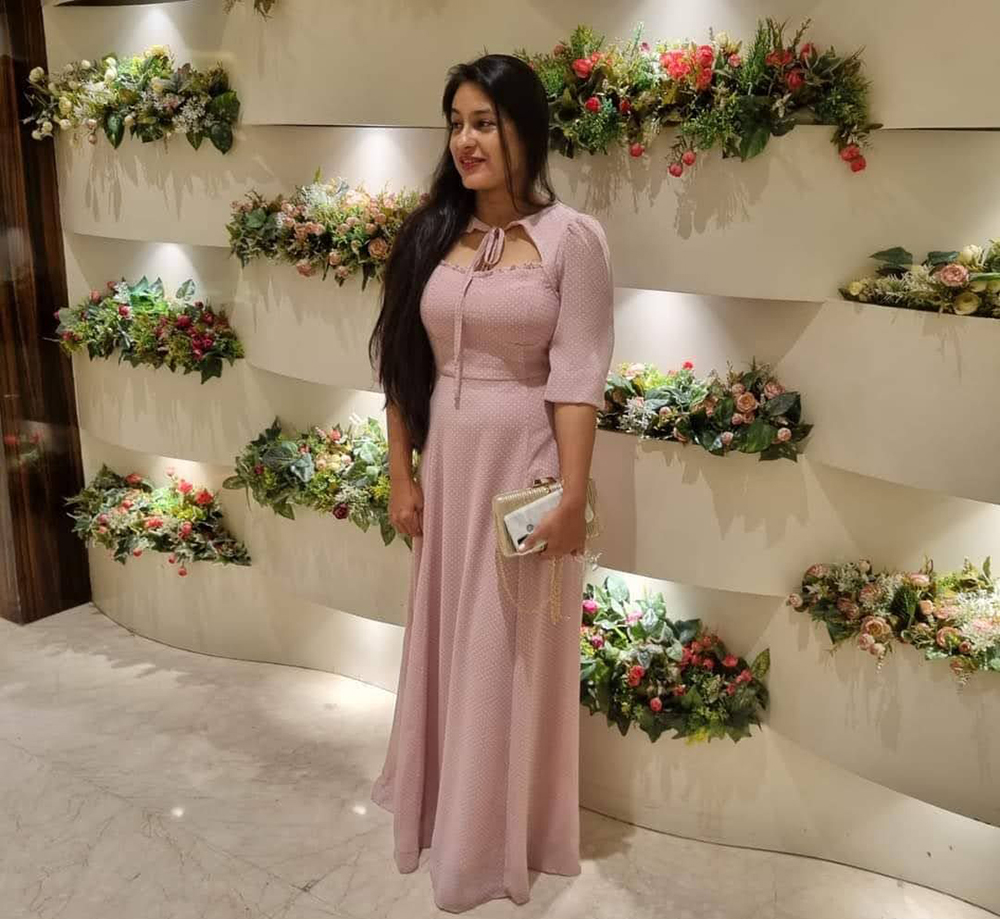
Aanya ate fast, the way she always ate when she was excited, shovelling food into her mouth with one eye already on the door. Gobindgarh Fort, she told me between bites. Maharaja Ranjit Singh made it magnificent. Daadu had explained the difference between building and making magnificent and she had filed it under things she now knew.

“Have you been inside?” she asked.
“Many times.”
“Did you like it?”
“I liked it very much. The ramparts.”
“What’s a rampart?”
“You’ll see today,” I said. “Remember to tell me.”
She pushed her plate back — two-thirds finished, which was better than I had expected — and launched out of her chair for her bag. I caught her by the sleeve.
“Collar,” I said.
She held still while I straightened it. Her neck was warm from sleep and she smelled of the chamomile soap I had put in her bathroom because she liked the way it smelled.

She was seven and I could still do things like that. I smoothed her plait. She submitted to this with the patience of a child who wanted to leave but loved me enough to wait one more minute.
“The note is in the front pocket,” I said. “For when you miss me.”
“I won’t miss you.” She was already moving toward the door. “I’ll be too busy.”
“I know. That’s why I put it there.”
She looked back at me from the doorway, briefly. The look she had when she wanted to be gone and was also making sure I was still there. Then she ran back and threw her arms around me. “I will miss you, Mama.”
“You won’t miss me if you miss the school bus, Aanu,” I said, kneeling next to her and hugged the one thing that made life worth living.
“Bye, Mama,” she said, her voice cracking just a little.

“Bye, baby.”
The school bus. She waved from the window, waved until the bus turned the corner and she could no longer see me. I knew this because I watched until the bus turned the corner and could no longer see her, and her arm was still going.
I stood at the gate after it had gone. There was no reason to stand at the gate after it had gone. I stood there anyway.
Then I went back inside and made my own tea and sat at the kitchen table in the silence of a house that was, for the next three days, entirely mine.
Small freedoms. I sat where I wanted. I didn’t straighten anything. I left my cup at the wrong side of the table. These were not rebellions. They were too small to be rebellions. They were just the shape that space takes when no one is watching.
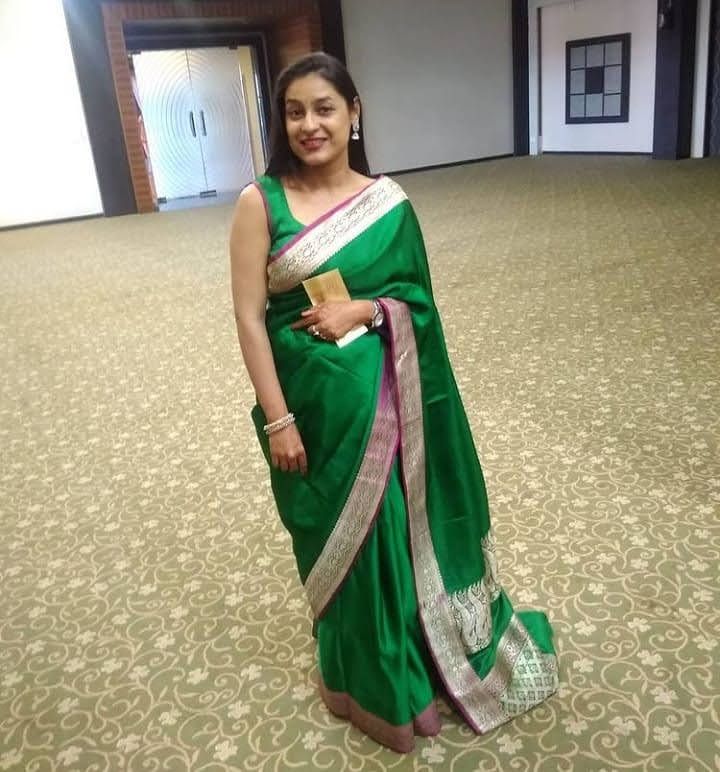
With no in-laws in the house and a kitchen to run, I dressed for the kitchen first and the guests second, a white churidar with a green embroidered kurta, the dupatta knotted at my waist where it would stay out of the way of the stove. No heavy jewellery. Gold studs, my watch, the thin gold bangle I wore every day. My hair pinned back. I would do nothing about my appearance before they arrived because there was too much to do and because the food would be better than anything I wore, and I knew it.

I started cooking at eight, which gave me six hours and was not excessive.
The dal makhani I had put on the night before, as I always did, the whole black lentils soaked and simmered long and low with the butter going in at intervals, not as an addition but as a development, so by the time it reached the table it would have been cooking for fourteen hours and the whole point of dal makhani, which is the depth and the unctuousness that can only come from time, would be visible in the colour and the weight of it. I had made it this way since I was eighteen, watching my mother, and it was the one dish I had never seen another kitchen match.
The sarson da saag had gone on first, at eight — slow-cooked mustard greens want time more than attention, and by the time the table was laid they would have had six hours. The paneer I made from scratch this morning: full-fat milk, slow to the boil, the lemon juice and the draining and the pressing, and then fried golden at the edges in ghee. The raita, the pickles, the papad. The matar pulao for bulk. The seviyan kheer cooling in the back of the fridge, sweet, cardamom-heavy, a small mercy at the end.

I cooked the way I always cooked when I was cooking for people who would taste it: with complete attention, in a kitchen that was entirely mine, without someone asking me every twenty minutes when it would be ready.
Ravi arrived back at twelve-thirty, just ahead of the delegation. He came through the kitchen, looked at what was on the stove, and said it smelled good. I took this as the highest form of approval he was capable of generating and continued stirring the matar paneer.
The guests arrived. Five men, including Marcus, and one woman from the delegation — Jasleen Dhillon, a trade attaché — British-Punjabi, sharp as a blade and kind about it, who came into the kitchen to compliment me before she’d been in the house ten minutes. I liked her immediately.
The table was laid in the formal dining room. I brought the food out with the kitchen helper, arranged everything, sat in my place. The familiar performance.
Marcus Webb was to my left. He said nothing to me directly in the first hour. He was attentive to the whole table, the way he had been at the dinner, listening, not waiting to speak. I felt the fact of his presence without looking at it directly.
The food was, as I had known it would be, something beyond what the occasion required.
Jasleen stopped eating the dal makhani after the first spoonful and looked at her bowl with the expression of someone recalibrating. “Mrs Sandhu,” she said, “I have to ask. How long did this cook?”
“Fourteen hours,” I said.
She looked at Ravi. “Your wife is extraordinary.”
One of the delegation men had gone back to the matar paneer twice without acknowledging it and was now on his third helping of the pulao. The Commissioner said the kheer was the best he had eaten outside his own mother’s kitchen, and he said it with the tone of a man who took that benchmark seriously.

Marcus said nothing. He ate with steady attention and once — just once — he looked up from his plate and found me watching the table and held the look for one beat before returning to his food.
Ravi said: “Outside the bedroom, food is her one talent.”
He was gesturing at me as he said it, with a laugh, to the table. Sharing a private joke with guests at my expense, in the comfortable way of a man who had never had to consider what it cost.
Some guests smiled. Jasleen didn’t. I felt Marcus, to my left, go very still.
I kept my face entirely neutral. I reached for the water jug.
The conversation moved on. I glanced at Marcus once, only once. His expression was equally neutral. We had both absorbed the moment without reacting.
The shared discipline of that — the parallel control, the identical choice — was its own form of communication. More intimate, in some ways, than anything we had said to each other at the dhaba. I had watched him do it once before, standing over the bullet holes at the Bagh.
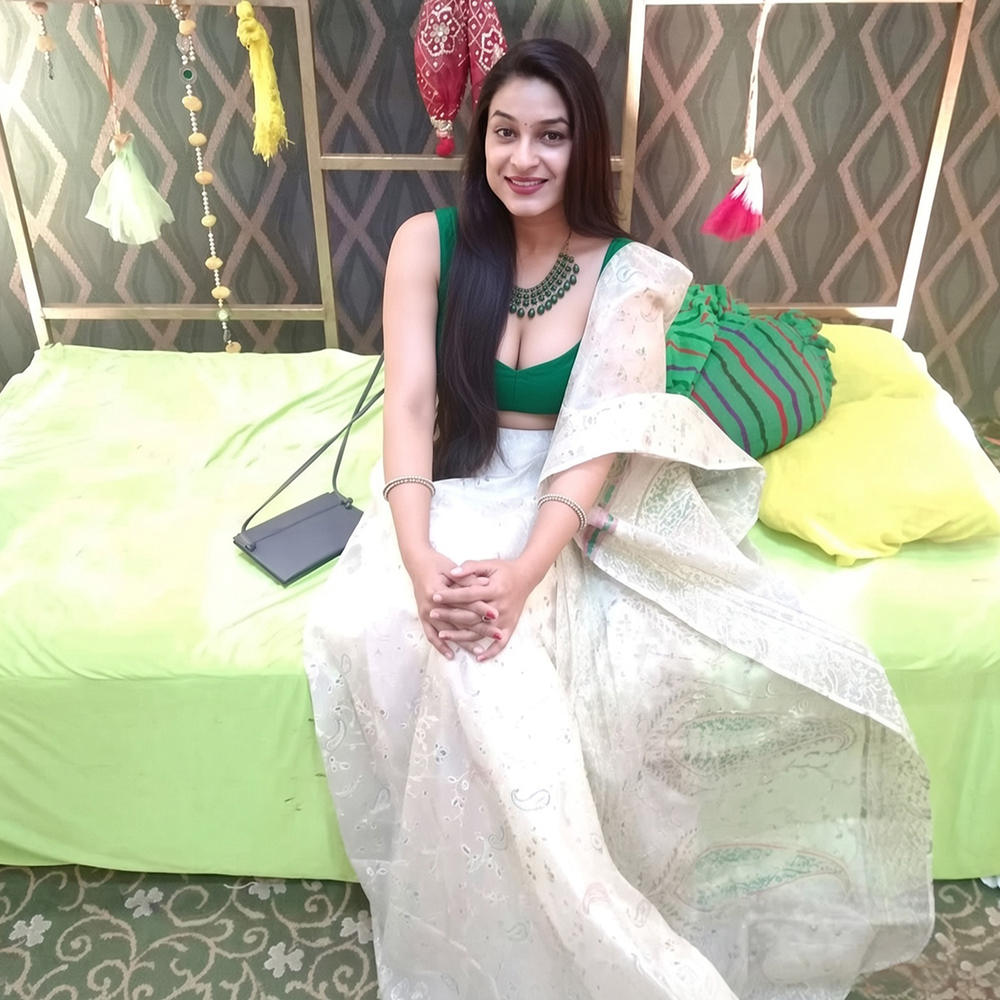
After lunch, while Ravi held court in the dining room and the guests settled into the comfortable positions of people who had eaten well, I was clearing the kitchen.
I heard footsteps, and Marcus was in the kitchen doorway.
He stood in the doorway, the awareness of where we were, of the dining room voices behind him, clearly present to him. He spoke quietly.
“I have no patience,” he said, “for men who treat women as their personal property.”
I set down the plate I was holding.
“He has been saying things like that for seven years,” I said. “To me. About me. It is not the worst of it.”
He held my gaze. Then he pressed his card into my hand: the hotel card, heavy stock, the hotel name embossed. I turned it over. On the back, in his handwriting: a room number and a mobile number.
“Call if you need anything,” he said. “Anything.”
He returned to the dining room before Ravi reappeared.
I stood in the kitchen holding the card.
Then I slid it inside my bra, against the skin over my heart.

The card stock was cool for one moment and then warm from my body. I stood with my hand flat against my chest for just a second, feeling the edge of it through the fabric, the fact of it pressing against my skin.
The thought of him handing it to me made me go warm in a way that had nothing to do with the August heat.
I went back to clearing the table.
The delegation left at four. At the door, Jasleen took my hand in both of hers and held it a moment longer than leaving required.
“That dal,” she said, “was worth the flight on its own.” And then, dropping into slightly accented Punjabi, low enough to stay between the two of us: “Some houses eat better than they deserve.” She held my eyes for exactly one second, released my hand, and walked to the car.
I stood in the doorway with my hand still warm.
The fifteenth of August arrived clear and already hot. I stacked the good bangles at both wrists — gold, and green glass to match the silk — because the day asked for festivity, and in this family such things were noticed.
Ravi approved the saree with a glance and a nod. We drove together to the ceremony ground in silence that was comfortable on his side and familiar on mine.

The ceremony was all surfaces: the dignitaries positioned with care on the official dais, the invited guests in their prescribed rows, the tricolour wound tight on its rope and waiting.
The band, military, perfect in their timing, impervious to the August heat in their uniforms. The crowd several rows deep, already proud before the flag moved, already feeling the collective pride that Independence Day generates in people who carry complex histories of what the word cost.
I thought, standing there with my pallu in place and Ravi’s hand touching my elbow in the social way — the for-appearance way — I thought about August of 1947.
The weeks of violence before the official celebrations. The camps along the Wagah road. The bodies in the fields that people stepped around to get to the ceremony that proclaimed the freedom. Independence as fact and as performance occurring simultaneously, with the same faces, on the same ground.

I did not make the parallel explicit in my own mind. I didn’t need to.
The flag moved. The tricolour unfurled against the August sky, and below it the crowd in a single movement of lifted faces.
My eyes found Marcus Webb across the official space. He was with the delegation, in the guest section, standing very still in the heat. He was looking at the flag.
Then he looked at me.
I looked away first.
The national anthem. My lips moved with the words I had known since I was four years old. Beside me, Ravi sang with the volume of a man who believed sincerely in the performance of patriotism. Around us, the crowd.
During the address, my eyes moved once more. Marcus was watching the speaker. Then — as if he had felt me looking — his gaze shifted sideways and found mine across the thirty feet of formal ground between us.
I looked away first. Again.
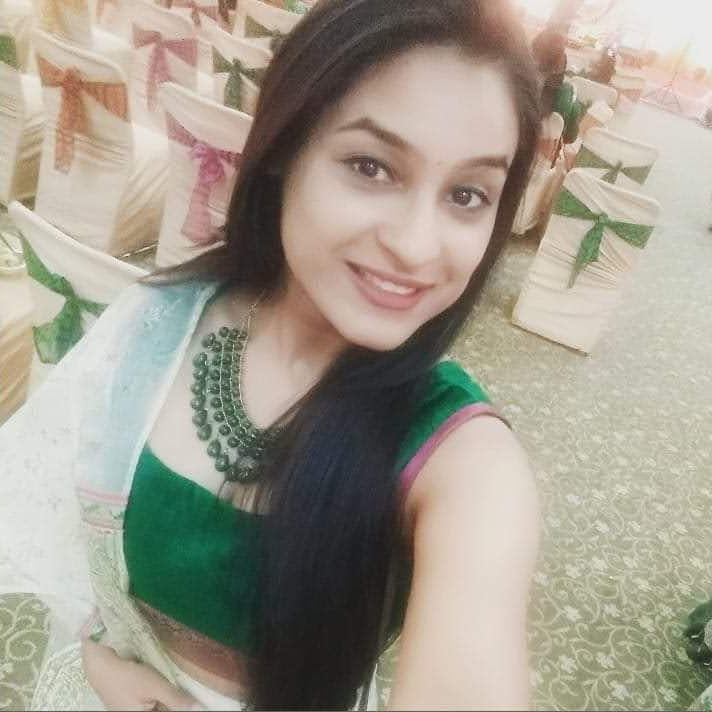
We were barely through the bedroom door.
He didn’t wait for me to undress. He never waited — not out of any preference for the saree, just the impatience of a man who wanted what he wanted and saw no reason to delay it. That said, he never forced himself on me either. Over the years, I’d learned that denying what he wanted would ruin the next day for everyone. Going with the flow was the choice I made every single time.
He was already reaching for me as the door swung shut, hands pulling the silk up from behind, finding the waistband of my petticoat, yanking it and my panties down to my knees in one movement. His fingers found my pussy briefly — checking, not for my benefit, just ascertaining — and then he was pushing me forward toward the bed.

I caught the bedpost. Bent forward. The card was still inside my bra, against my skin, its edge a small pressure point just above my heart.
“That’s it,” he said, from behind me, settling himself, finding the angle. “Good girl.”
He pressed in, no preamble, unhesitating, someone who had done this enough times to consider it simple, and made a low sound of satisfaction at the back of his throat. “Fuck. Yeah. There it is.”
He held my hips and set his pace. I held the bedpost.
I was not in the room. I was in the room in body — my knuckles white around the carved wood, the silk pooled at the small of my back, the blouse still buttoned at my chest with his card pressed flat behind the fabric — but I had learned over seven years how to be elsewhere, and I went there now.
Not to Marcus. I would not take Marcus into this room. I went to the blankness I had cultivated carefully over seven years, the grey place where nothing Ravi did could quite reach me.
“Such a tight little pussy,” he said, finding his rhythm, talking the way he always talked when he was close, half to himself, half to the act. “Every time. Gets me every fucking time.”
He drove in harder, the headboard knocking the wall. “My wife. Mine.” A laugh, low and satisfied. “Webb couldn’t stop staring at you at the ceremony. Probably wondering what this feels like.” Another thrust. “Maybe I should let him find out. For the deal. Diplomatic relations.”
He laughed at his own joke.

I gave him the sound he needed, placed exactly where he expected it. He took it as his due and drove in a final time and came with a long groan and the satisfaction of having had exactly what he wanted.
He held still, spent. Then withdrew.
I stayed bent over the bed. The silk fell back around me. My panties were still at my knees. The bedpost had left its impression in my palm. The card was still against my skin.
Then he started talking.

His breathing was already evening out, he had exerted himself briefly and was already on to the next thing. “I noticed Webb watching you at the ceremony. The man is interested, it’s obvious.” A pause.
The sound of him reaching for water. “The deal needs to close. A gesture from us — something personal, something the delegation feels rather than just negotiates.” Another pause. “It’s only sex, Sneha. You’re a grown woman. I’m not asking you to do anything you haven’t done before. Clearly he wants your cunt. Let him have it. For the family.”
The room was very quiet.
I did not move. I was aware of my own breathing, the warmth of the room, the faint ache at my knees from the position, and the absolute surreal stillness of what I had just heard. I wasn’t shocked at what he had said because some part of me had been waiting, for seven years, to hear what he actually thought of me. Now I had it, plainly stated, without even the courtesy of cruelty. Just logistics.
He got up. Bathroom sounds. He came back and dressed while I remained where I was. A brief contact of his palm against my lower back, casual, proprietary.

“Make it work, theek hai,” he said pleasantly, the way he said everything that was an instruction dressed as a suggestion. “Take the initiative if he won’t. For all of us.”
The door closed.
I lay there.
The card was against my skin. I had not needed to take it out. It had been there all along.
Eventually I sat up. I pulled my panties up. I let the saree fall back into its folds. I went to the mirror and stood in front of the woman in it, silk saree, pallu still pinned, mangalsutra, everything in place.
Her face was very calm.

By evening he was dressed for going out, the other register, the night-out register, different shoes, extra aftershave.
“Friends,” he said. “Don’t wait up.” His phone was already in his hand, something already pulling his attention. The door. His footsteps on the stairs, the entrance hall, then the car.
The gate. Then silence.

The house was completely, entirely empty for the first time in my marriage. Not just quiet — empty. No in-laws, no Aanya, no Ravi. The staff had gone home hours ago. It was their Independence Day too. Just the house and its breathing and every one of its rooms at my disposal, which should have felt like freedom and instead felt like standing in the centre of a very large question I had been declining to answer for seven years.
I tried to eat. I made myself a plate: leftovers from yesterday’s lunch, the dal makhani, some roti. I sat at the dining table. The food was fine. I could not taste it.
I burned the roti I was trying to warm. I turned the stove off and sat back down.
I reached inside my blouse and took the card out. Set it on the table in front of me. Hotel name, room number in his handwriting, his mobile number. I picked it up. I turned it over in my fingers — the weight of the stock, the ink — and the decision, I understood, was already further along than I had been admitting, and not because Ravi had asked me to take the initiative. I reached for the phone, then set it back on the table, face down.

I was crying when the phone rang. I didn’t know I had been crying until the phone started buzzing. I turned it around. Ravi’s name on the screen. I wiped my face before answering, which was a reflex I noticed with the part of my brain that noted things even when the rest of me was occupied.
“Just calling to check,” he said. Behind him: music, voices, crowd sounds that come from a private room. A woman’s voice very close to the phone, close enough that she was in contact with him, the proximity unmistakeable. A sound that was the beginning of kissing.
“Ravi —”
“Don’t wait up,” he said. His voice already somewhere else, already in the room he was in and not the call he was on. “I won’t be back until Sunday night. Maybe Monday. Tell the staff I’ll call.”
The line went.
I sat with the phone in my hand.
The card was still in my hand. I had not put it down.
I showered. Not for Ravi, not for anyone’s approval, a hot shower, long, the kind I only took when the house was mine. I washed my hair properly and stood in the steam for longer than was efficient.
In the bedroom, I looked at my wardrobe.
The saree from this morning was on the chair. I left it there. I went through to the other side of the cupboard, where my own clothes lived, the things I wore when I took Aanya to school, when I went to the market, when I had been, briefly, a person going somewhere of her own choosing.

I chose a churidar-kurta, deep blue, simple neckline, nothing I was choosing to impress anyone. I held it up. Then I put it back. Chose another, the same register, but the fabric sat with a little more weight — present without being sheer — the neckline sitting differently, a small and undeniable difference. I had bought it a year ago and not worn it.
I looked at myself in the full-length mirror. The churidar, my hair damp and loose, no jewellery but the mangalsutra and nose stud that I never take off.
And then, for the first time in longer than I could account for, I looked. A woman of thirty-five looked back. Slim — slimmer than the saree ever admitted, the saree being an instrument of dignity rather than truth — with the fullness above the waist that seven years of tailored blouses had been instructed to contain rather than announce. The waist itself, which the churidar found and held. Skin the colour of milky chai, darker at the forearms where the kitchen and the school gate had had their say. Hair past my shoulder blades, damp and heavy, the one vanity I had never surrendered. My mother’s mouth. And below my lower lip, to the right, the mole — the dark point I had spent my twenties hating. The aunties had called it a nazar ka teeka, God’s own thumbprint against the evil eye, which is the kind thing people say about a flaw. Ravi had not mentioned it once in seven years, which was its own information. I looked at it now and did not cover it with my hand. Beside my nostril, the small diamond stud caught the light — the one piece I had chosen for myself, before the marriage, and kept. Dark eyes, tired at the edges and not tired anywhere else. I stood there and took inventory of a body that had spent seven years as household equipment and an instrument of convenience.
I looked for Ravi’s wife and Aanya’s Mama, and a woman looked back. It was an introduction. For seven years I hadn’t met her. It was time to meet her now.
I reached up and took the mangalsutra off.
I left.

I called from the car, parked outside the hotel.
He answered on the second ring.
“It’s Sneha Sandhu,” I said. “I was wondering —” I stopped. Started again. “I was wondering if I could come up. To talk.”

A pause. Not a long one. “I’ll leave your name at the front desk,” he said.
The lobby of the hotel was all stone and low light and the smell of fresh flowers. The woman at the front desk found my name, checked her screen, handed me a slip of paper with the floor. Her face was entirely professional. I was aware, with the rational part of my mind, of how this looked. With every other part of my mind, I was aware of the lift doors, and which floor, and the direction of the corridor.
His door. He answered before I had finished knocking.
He was in a plain white shirt, no jacket, the sleeves turned up past his forearms. The room behind him was lit warmly — a lamp, not the overhead — and there was tea on the table. The ordinariness of it undid me slightly. The kettle, the two cups, the thoughtful preparation of it. He had made tea. He had expected me to need to sit and talk, and he had made tea.
I walked past him into the room. He closed the door.

We sat. He poured. I held the cup with both hands and looked at it.
Then I talked.
Not about Ravi directly. Not the marriage in legal or factual terms, not the arrangement or the deal or this afternoon’s obscenity. I talked about the other thing — the accumulated thing, the thing beneath the incidents.
Seven years of making myself smaller. Of knowing exactly what was happening in every room and being permitted to manage none of it. Of performing contentment in front of people who would never believe me capable of discontent. Of the exhaustion of being always, always the one who pretended everything was fine, who made sure the flowers were at the right height and the food was hot and the guests were comfortable and nobody had to feel the discomfort of noticing what this house was.
Of Aanya, who was the truest thing in it, and who was also the reason I could not leave. Not yet. Maybe not ever.
He listened. He did not offer me solutions. He did not reassure me that it would get better or suggest I had options he had already thought of that I hadn’t.
He sat with it the way he had sat at the dhaba when the responsible self came back over me, as a witness, fully present, not requiring me to resolve anything for his comfort.
At some point I stopped.
The room was quiet. The tea was cooling in the cups.
He reached across the space between us and took my hand.
I looked at his hand over mine. Large, warm, steady.
Then I looked at him.
The distance between us was small.
I was the one who closed it.

The kiss began the way real kisses begin, slowly, with permission being given and received before anything was asked, the quality of a first kiss between two people who are both aware of what they are beginning.
His hand came up to my face. I felt the size of it against my jaw, the warmth of his palm, and I stopped thinking about anything outside this room. His thumb brushed the mole below my lip and stopped there. “I noticed this the first night,” he said, against my mouth. “Across the room, before I knew your name.” He kissed it — precisely, that one dark point — before he kissed my mouth again.
He pulled back once. Just to look at me, really look at me. The question was there in his eyes, and it was a real question, and it deserved an answer.
I answered it without words.
He did not ask again.

His hands on the buttons of my kurta were careful, which was not the same as hesitant. The difference mattered. He was deliberate, attending to each button as if there was no reason to hurry through this toward the next thing, as if this itself was worth having.
I was being looked at. This sounds like a simple thing. It was not a simple thing.

There is a way that men look at women that is about assessment: inventory, approval, the private calculus of desirability as a function of their own preferences. I knew that look. I had been on the receiving end of it for the entirety of my adult life. Then there is the other kind: someone who is seeing. The difference between being assessed and being seen registered in my body before my mind named it.
He helped me out of the churidar. His hands on my hips, just holding, not directing, not positioning. The intimacy of being held still without being held in place.
I reached for his shirt buttons and he let me, watching my hands, and then I was looking at the width of his chest, the dark skin of it, the salt-and-pepper hair.
I pressed my palm flat against his sternum the way I had pressed my own hand against mine on the couch two nights ago. His heartbeat under my hand.
He picked me up as if I weighed nothing.

On the bed, he turned me onto my back. He moved down the length of me and he did not hurry.
His mouth at my throat, my collarbone, then at my breasts, his tongue on my nipples, slow and thorough, his hands cupping the weight of them while his mouth worked, and I heard myself make a sound I hadn’t planned.
He stayed there, learning me, his thumbs tracing circles on my skin, until my back arched into him and I had stopped thinking clearly about anything.
Then his mouth moved down across my stomach and further, his shoulders settling between my thighs.
He stopped.
His thumb had found the second one — the small dark mole beside my slit, close enough that only two men had ever seen it, and only one had ever looked.

“A matched set,” he said, with real delight in it, and then he kissed it. Not my pussy. The mole.
His mouth settled on that one dark point and stayed — kissing it, then licking it, slow deliberate strokes a breath away from where I was already aching for him, his stubble grazing my inner thigh, the warmth of his breath falling exactly where his tongue refused to go.
My hips tilted toward his mouth. He didn’t follow. My hand went into his hair and pulled — guiding, then begging, the distinction collapsing fast — and he let himself be moved not one inch, his hands flat on my thighs, holding me open, holding me exactly where I was.
“Marcus.” His name came out of me like a demand and a plea at once.
“I know,” he said, against the mole. And made me wait one breath longer.

His mouth on my pussy was not a preamble, not a formality. It was something entirely new.
He adjusted to what my body told him, finding the rhythm and the pressure on my clit that made my hips shift and my breath change, and then staying there. Not moving on. Not rushing through it toward something he considered more significant.
He stayed there, thorough, his tongue working me in long deliberate strokes and then tight focused circles, until my thighs were shaking against his ears.

I had completely given up performing and the sound I made into the pillow was entirely, embarrassingly, honestly my own as I came in his mouth. He stayed with me, making the orgasm last.
When it finally passed, I lay catching my breath, eyes on the ceiling.
“That,” I said, “is what it’s supposed to feel like.”
He moved up beside me. He didn’t say anything. Just kissed me and I tasted myself on him.

I reached for him. Found the waistband of his trousers, the zipper, and then the weight of his cock in my hands, and the breath went out of me.
He was — I had no reference point for this. I had one experience for the entirety of my adult life, and Ravi was an ordinary man, and Marcus Webb was not an ordinary man in this way. The length of him was one thing. The girth was another, the fact of what my fingers could and could not close around, what my palm could and could not encompass. The imagining I had done on the couch — the wondering, the careful construction of something larger than I knew — had not been excessive. It had not been enough.

I held him and looked at him and looked up at him.
“Take your time,” he said. A slight smile.
I took my time. I learned him with my hands first, the weight and the heat and the texture of him, the way his breathing changed when my grip shifted, the way his cock thickened further when I stroked him slowly from root to tip.
Then I bent and took what I could into my mouth, working what I couldn’t with both hands, his balls heavy and warm in my palm. I took my time because he had offered it and because I wanted it.

His hands came into my hair, not directing, not pushing, just present. The sound he made when I found the right combination of pressure and pace was low and involuntary and I kept going until he came, and I took that too, because I wanted to.
Afterwards he lay back, and I moved up to sit beside him. He looked at me with an expression that was warm and present and entirely uncomplicated.
I looked at him. He was propped against the pillow, watching me with the patient attention he brought to everything, and what he was offering was plain.
Ravi had never gone down on me. In seven years, not once. It was not something he considered part of the arrangement, and I had learned not to consider it either. Marcus had already given me one orgasm that way, which meant I knew now that the thing I had stopped expecting was real and available and — the thought arrived quietly — perhaps available again, if I reached for it.

I moved over him.
The vulnerability of straddling his face was enormous, my weight over him, my thighs on either side of his head, my pussy bare inches from his mouth, nothing between us, and it sat right at the edge of what I could hold without retreating. His hands came up and settled on my thighs and he kissed the mole. Then he pulled me down to him without hesitation, as if this was exactly where he had been intending to be.
His mouth found my pussy.
And I understood, immediately, that he was not doing me a favour.
He was enjoying himself.
The sounds he made were low and unperformed, the sounds of getting something he had wanted. His hands moved from my thighs upward, finding my waist, my stomach, my tits, not directing me but mapping me, learning the weight of me above him, and when his palms closed over my breasts and his thumbs found my nipples he made a sound that came up through the back of his throat and vibrated against my clit and my fingers went into his hair without planning to.

“God,” he said, against me, and the word was warm and absolutely sincere. “You’re beautiful.”
I moved the way I wanted to move. At my own pace, at my own angle, taking the pressure where I needed it and pulling back when I needed that too. His hands stayed at my waist, steadying without controlling, and every time I shifted he adjusted, following me, his tongue working my clit with thoroughness and patience.
“Every inch of you,” he said, in a break between breaths. His thumbs traced the undersides of my breasts, the curve of my stomach, the hollow of my hip. “Every single inch.” He pressed his palms flat against my skin as if he wanted to cover as much of me as he could reach. He didn’t say it, but everything he did was telling me I deserved this. That I’d denied myself what I deserved for way too long.

My throat tightened, and I hadn’t expected it to.
I pressed down harder into his mouth. He welcomed it, his hands on my hips now, holding me to him, staying with me through the shaking that started in my thighs and moved upward. I came with his name in my mouth, which surprised me. I had not planned to say anything.
He moved me down to lie beside him. We were quiet, the comfortable quiet of two people who have nothing to perform for each other.
Then he reached for me, and I moved toward him. This time the question was in the way his hand settled at my hip and waited — his cock heavy and hard against my thigh, his eyes steady on mine — and I answered it by drawing my knee up along his side and pulling him over me. That was the easy part.
What followed was anything but.

He was patient. More patient than anything I was prepared for. He pressed the head of his cock against me and pushed in slowly, incrementally, with pauses when my body needed them, reading the change in my breath the way he had read everything. My pussy opened to him in stages: the first stretch of him, the fullness of two inches, three, the moment — halfway, two-thirds of the way in — when I thought this was everything there was, and then the further he went. My fingers gripped his upper arm.
“Still okay?” he said, against my temple.
“Yes.” The word was barely a word.

He pressed the rest of the way in. Slowly. Until I had all of him.
I lay with my eyes open, looking at the ceiling of this room that was not my ceiling. He held still, his cock completely inside me, his weight on me but not crushing. He was watching me, his lips brushing against the mole I no longer hated.
I looked back at him.
Seven years of the ceiling of my bedroom. The plasterwork, the ceiling fan, the absence that had been my experience of this for seven years.
This was not the ceiling.

I moved my hips. He drew back and I could feel the emptiness where he had been. Then he pushed forward again and I felt every moment of that too.
He set a pace that was slow enough to feel every stroke, the drag and the press and the fullness of his cock filling me, the withdrawal that never felt like loss because the return was already beginning. His forehead dropped to mine.
I put my hands in his hair. His rhythm deepened, and I tilted my hips to meet it, and we found the angle that made the sound go out of me, and he stayed at that angle, deliberately, for long enough that I lost track of the room entirely.

We came close to the same time, him first, me a breath behind, close enough that I finally understood what the films had been reaching for.
We lay quiet. His heart against my shoulder.
Later — I don’t know how much later — he moved us. Sideways.
His chest against my back, his arm over me, his mouth at the back of my neck.

His cock found me again from behind, slower now, languid, two bodies that have learned each other and have no reason to perform efficiency.
His hand moved on my stomach, my hip, slid forward between my thighs and found my clit while he pressed into me from behind, and I arched back against him and let him take me apart from the inside while his fingers did the rest.
When we finished this time, it was with the weight of an evening that was complete.
We were still for a long time.

In the dark, we talked.
Not about what came next. Not about logistics or consequences or morning. Two people still present with each other, in the intimacy of a room that has heard everything.
He told me about his wife. More than before: her name (Patricia), her laugh, the way she had of being right about everything without being unkind about it. The last year of her illness and how it had been both terrible and ordinary, the way serious things become ordinary when they go on long enough. The first morning after she died and the wrongness of the light in the bedroom.
I told him about Aanya. Everything. The note in the front pocket of the school bag. The incorrect facts delivered with absolute certainty. The way she submitted to having her collar straightened for approximately eight seconds before her tolerance ran out.
He said: “She sounds magnificent.”
“She’s everything,” I said.
A silence. Not uncomfortable.
“I need you to know,” I said. “This wasn’t because of what Ravi asked me to do.”
“I know,” he said.

“You couldn’t know.”
“I knew from the dhaba,” he said. “From the way your face changed when you were talking about Ellora and Hampi and Rome and everything you’d mapped in your head. From the way you laughed at me on the charpoi.” He was quiet. “A woman doing her husband’s errand doesn’t look at a man like that.”
I was quiet.
“Like what?” I asked, eventually.
“Like he’s the first person in a long time who was actually worth looking at,” he said.
I lay in the dark beside him. The city was quiet. Through the window, very faintly, the sound of a late firework, Independence Day celebrations still ongoing somewhere, far away.
I thought about independence. The word itself. The distance between the word and the thing it named, and how long it sometimes took — in nations and in people — for them to arrive at each other.
I closed my eyes.
The water was cold by the time we noticed.
It had started hot. His hands in my wet hair, working the water through it, and for a long minute that was all it was — a man washing a woman’s hair, thorough about it the way he was thorough about everything, and me with my eyes closed and my forehead against his chest, letting him.

Then his mouth found my throat and the register changed.
My back met the tiles — the cold of them against my shoulder blades, the heat of him in front — and his mouth moved down: my throat, my collarbone, my nipples, the water running between us, until my nails found his shoulders and my breathing was louder than the shower. He lifted my leg, set my foot on the low shelf, and went to his knees on the shower floor as if the position cost a man his size nothing, which it visibly did, and which he visibly did not care about.
His mouth on my pussy with the water coming down was a different thing from the bed. Everything wet, everything warm, his tongue on my clit and the spray on my breasts and no way to tell where one sensation handed over to the next. I came with my fingers in his hair and my head back against the tiles, and the sound I made went up into the steam and stayed there.

Then it was my turn with him — on my knees on the shower floor, the water warm on my back, his cock in my mouth, one of his hands flat on the wall and the other resting at the back of my head, present without pressing.
I took my time.
I had not run out of interest in learning him: the weight of him on my tongue, the way his breathing shortened when I used my hand and my mouth together, the low sound that came out of him when I looked up.
He came with a sound that filled the small bathroom, his hand sliding on the wet tile for balance, and I stayed with him through it.
Then we were standing against each other, both of us breathing hard, my hand stroking him till he was hard again.

Then he pressed his cock into me from the front with a decisiveness that said he had thought about it and decided it was worth asking, and I said yes by pulling him in by the hips. He lifted me — both my legs around him, my back full against the tiles, his hands under my thighs — and I registered, briefly, the strength this required, the fact that he held me as if my weight were a rumour, and then I stopped registering anything except the depth the position gave him and the sound of the water and my own voice, unguarded, ringing off the tiles of a hotel bathroom on the morning of the sixteenth of August.
The water ran cold at some point. We noticed when it stopped being negligible.
He reached past me and turned it off.
We stood in the sudden quiet of the bathroom, dripping, and looked at each other, and he laughed — a real, unguarded laugh, the kind that takes over a face — and I started laughing too, which I had not expected to be doing in this bathroom on this morning.
He handed me a towel. There was something both domestic and surreal about this, the two of us drying off in the hotel bathroom, the ordinary intimacy of it.
I went back into the room to find my clothes. My churidar was on the floor beside the bed from last night. I picked it up, found the underwear a few feet away, and stood there with both items in my hands.
He was in the doorway of the bathroom, his own towel around his waist, watching me.
“Do you have somewhere you need to be?” he asked.
I stood there.
Aanya came back Monday. Ravi had said Sunday night, maybe Monday. The house was empty. No one was waiting for me, no one was watching for me, no one needed me to perform a version of myself until Monday at the earliest.
I looked at the underwear in my hand.
I let it drop.
He was still in the doorway, the towel at his waist, watching me with the beginning of a smile he had not yet decided to have.
I crossed the room and took the towel off him. He let me — one eyebrow going up — and then my hand was around his cock, feeling it stir and thicken against my palm, and I watched the surprise arrive on his face and become something considerably better than surprise.
“I have until Monday,” I said. “I intend to use all of it.”
THE END
I always look forward to your feedback.
Please comment on the story to let me know what you liked about it.